

New Mexico Accelerates Medical Psilocybin Program, Advancing Access to Care by December 2026
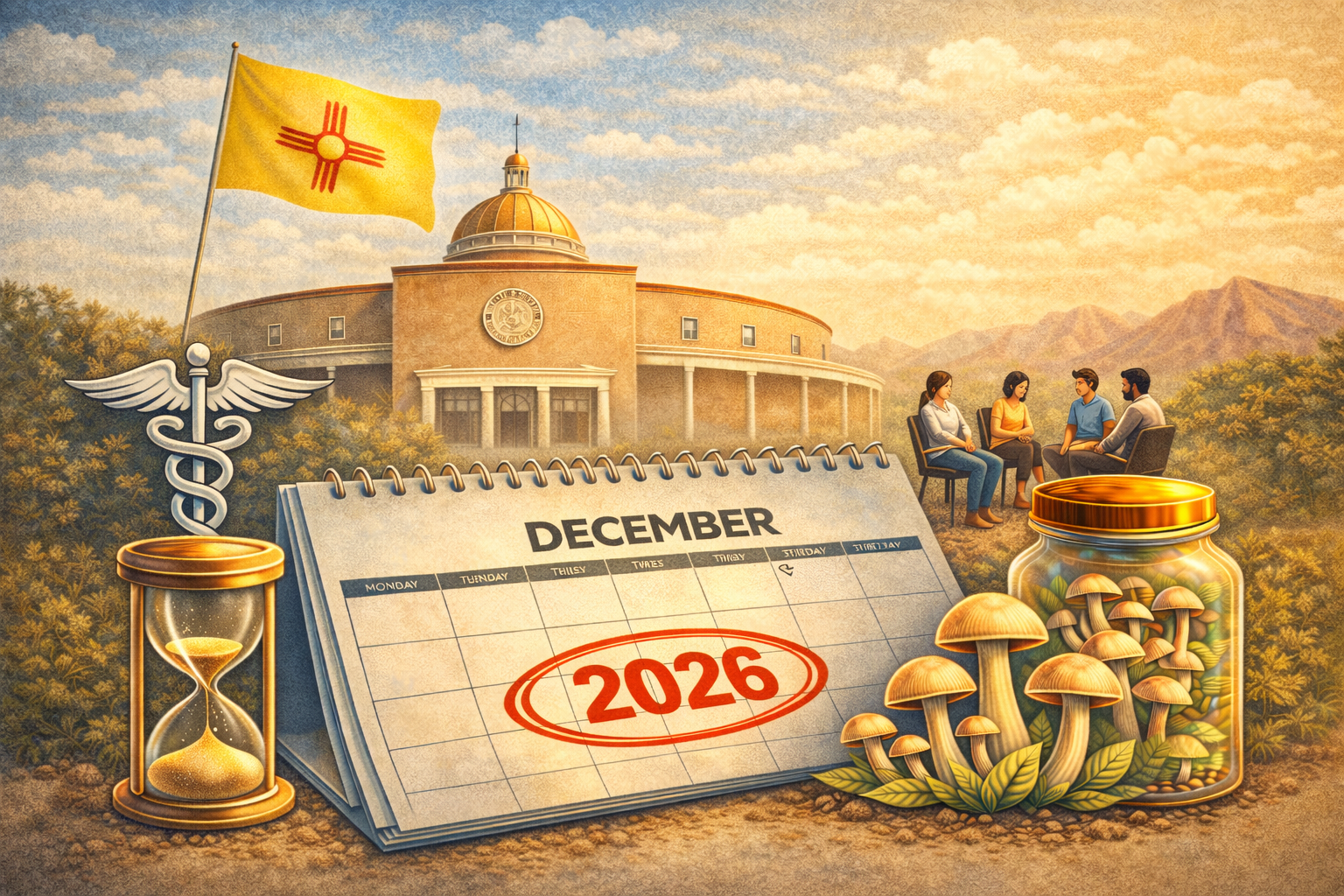
New Mexico is moving faster than expected to implement its medical psilocybin program, with initial patient access now anticipated by December 2026—a full year earlier than originally required. The acceleration reflects strong public interest as well as the urgency of unmet mental health needs across the state.
The program was authorized through the Medical Psilocybin Act (SB 219), passed in April 2025, and is now entering an active rulemaking phase. The Medical Psilocybin Advisory Board, convened by the New Mexico Department of Health, began meeting publicly in December and is responsible for shaping clinical standards, training requirements, licensing structures, and care delivery models.
Who’s At The Table
The advisory board brings together clinicians, researchers, advocates, and community voices to guide program development. Members include:
Brenda Burgard, Licensed Therapist
Alanna Dancis, Medicaid Chief Medical Officer and Nurse Practitioner
Ian Dunn, UNM Nursing and Psychology Student and PTSD Patient Advocate
DezBaa, Storyteller and Licensed Massage Therapist
Dan Jennings, Town Counselor and Nonprofit Mental Health Advocate
Dr. Larry Leeman, University of New Mexico Physician Specializing in Family and Addiction Medicine
Chris Peskuski, Veteran Advocate and Peer Support Leader
How PMHA Alliance Is Connected
PMHA Alliance has a direct relationship with the state’s advisory process. Two advisory board members—Dr. Larry Leeman and Chris Peskuski—are also members of the University of New Mexico research team that PMHA Alliance is partnering with to develop and implement a Group Psilocybin-Assisted Therapy (GPAT) study for PTSD, currently in the design and recruitment phase.
Dr. Leeman is serving as Principal Investigator, and Chris Peskuski is serving as a veteran peer facilitator supporting veteran and first responder participants. As the study moves toward implementation, it is aligning to function as a practical learning resource for the state, generating early insights that can help inform the advisory board as it develops regulations, care standards, and reimbursement models during this initial phase of program rollout.
PMHA Alliance is also engaged directly through subcommittee participation. Hanifa Nayo Washington, Co-Director of PMHA Alliance and now a resident of New Mexico, is currently serving on three advisory board subcommittees, contributing to discussions on care delivery, implementation, and access considerations.
Partner Perspectives
The Healing Advocacy Fund (HAF), one of PMHA Alliance’s core partners in New Mexico, has been actively engaged in the advisory process and subcommittee work. Denali Wilson, New Mexico Director of Strategic Support at HAF, emphasized the importance of pairing urgency with care as the program advances:
“While it is important for the program to move forward with urgency, achieving the right balance of safety and affordability will require careful attention and thoughtfulness.”
Advisory Board Subcommittees
The advisory board is currently working through the following subcommittees:
Equity, Access, and Cultural Considerations
Propagation
End of Life Care
Research & Continuous Improvement
Training and Education
Dosage, Administration, and Clinical Practice
Patient Qualification and Safety
From Planning To Early Implementation
PMHA Alliance met with the New Mexico Department of Health early last year to share strategies focused on access-oriented pilot models and learning-driven implementation approaches.
At the State Medical Psilocybin Advisory Board’s first meeting, Dominick Zurlo, Director of the Center for Medical Cannabis and Psilocybin at the New Mexico Department of Health, emphasized that December 2026 represents an initial launch milestone rather than a fully built-out program.
“Because there has been such large interest in this and a push for us to be able to help people with psilocybin treatments earlier, we have set a goal now to be able to see initial patients by the end of December of 2026,” Zurlo said.
State health officials noted that not all elements of the program will be fully established by that date. Instead, the aim is to begin serving a limited number of patients within the medical system, allowing early access to care while regulations, reimbursement models, and operational systems continue to be refined.
As rulemaking continues through 2026, New Mexico’s approach is shaping a medically grounded pathway for psilocybin-assisted care—one informed by research, public input, and early learning, and closely watched by other states considering similar programs.
…
To stay up to date on the Medical Psilocybin Program and Advisory Board:
→ Medical Psilocybin Advisory Board (updates, meetings, records, members, etc):
https://www.nmhealth.org/about/mcpp/mpp/mpab/